Add sign-in to your service
Each Revoked server is an OpenID Connect provider. Use the authorization-code flow with PKCE and approve through the app. A web component, Flutter package and complete demo service are available.
Integrate sign-in ↗Use the public API to read current data from shares, collect responses, add OpenID Connect sign-in, or build a connected tool. People review and approve the access your integration requests.
Each Revoked server is an OpenID Connect provider. Use the authorization-code flow with PKCE and approve through the app. A web component, Flutter package and complete demo service are available.
Integrate sign-in ↗Read a share as JSON, CSV, vCard or iCal. Resolve grants when you need their current values and respect expiry, revocation and cache limits.
Shares & grants ↗Propose shares, requests or attestations for owner approval. A basic connection reads status and views; further access is explicitly granted. Scoped API keys serve your own scripts.
Build a tool ↗Receive request responses through callbacks, subscribe to webhook events, verify presentations or connect an assistant through the MCP interface.
Ways to connect ↗Use the official server for test data or start the Go service locally. Production base URLs belong to each server operator.
Use an API key for your own automation, a connected-tool flow for another person’s app, or OpenID Connect for service sign-in.
Account for paused, expired and revoked links, server outages and permission changes. Parse error codes instead of matching message text.
The server and app are open source under AGPL-3.0; a modified version offered as a service must publish its source. The SDK packages and examples are MPL-2.0 and can be used in applications under any licence.
Applications with their own interface, using a Revoked server for storage and access control.
 Packet
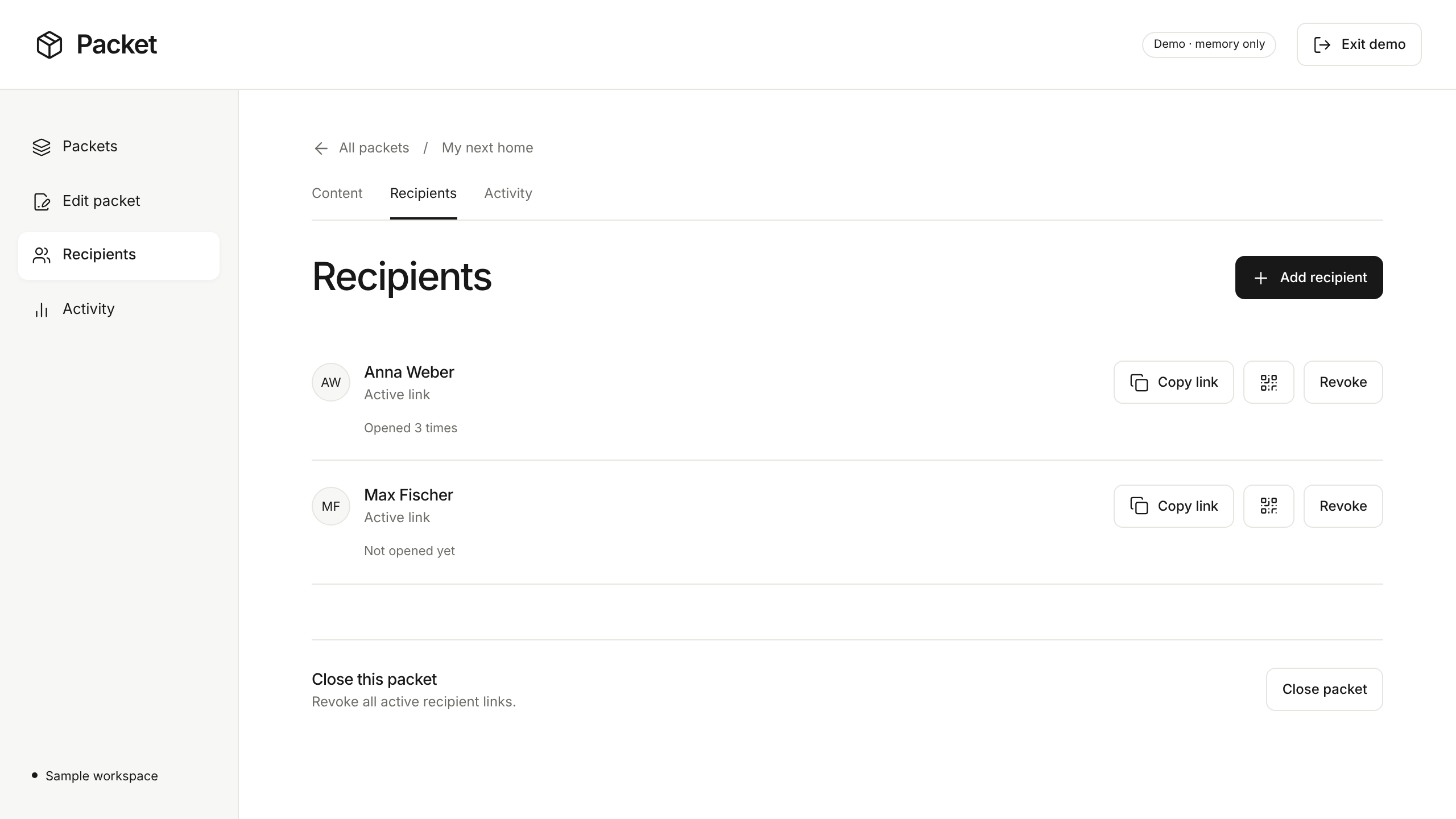
A browser app that bundles documents and details into one packet, with a separate link for each recipient. Records live in a section under Packet’s own connection; each recipient link is a share. Packet has no backend or database of its own. The connection is approved in the Revoked app and can be paused or disconnected there.
Packet source code ↗